
TypeScript’s 10x Faster Leap:Latest Go Advancements
- Harsh Gupta
- 11 Jul, 2025
- 04 Mins read
- Development
TypeScript has long been the developer’s favorite for writing robust, type-safe JavaScript. Developed and maintained by Microsoft, it continues to evolve in response to growing codebases, demand for performance, and modern tooling needs.
In early 2024, Microsoft announced one of the most ambitious changes to TypeScript since its inception—a native compiler rewrite in Go. The goal? Massive performance boosts, especially for large-scale projects that have faced limitations with the current JavaScript-based compiler.
Why the Rewrite? Performance Bottlenecks and Scalability
As adoption of TypeScript has surged, projects like Visual Studio Code, Angular, and massive enterprise applications now span millions of lines of code. While the JavaScript-based compiler tsc is battle-tested and feature-rich, it wasn’t built with this kind of scale in mind.
Key Challenges with the Original Compiler
| Issue | Impact |
|---|---|
| Slow compile times | Wasted developer hours during build |
| High memory consumption | Crashes or hangs in large projects |
| Limited concurrency | JavaScript’s single-threaded nature becomes a bottleneck |
| CI/CD bottlenecks | Slower release cycles and build queues |
| Developer experience | Delayed feedback loops, lower productivity |
The limitations were not just a technical concern; they were affecting the developer experience and slowing down team velocity in fast-paced environments.
This is the same TypeScript you know and love, just faster, more scalable, and ready for modern development at scale.
TypeScript Goes Native: The Go Compiler Initiative
In January 2024, Microsoft introduced an experimental port of the TypeScript compiler in Go, hosted on GitHub as microsoft/typescript-go. This wasn’t just a proof of concept—Microsoft shared real benchmarks demonstrating 10x faster builds.
Core Goals of the Go Compiler
- 10x faster builds for large projects
- Lower memory footprint to reduce crashes
- Scalability across multi-core systems
- Compatibility with existing tooling
- Future extensibility for enterprise needs
Real Benchmark Data: TypeScript vs TypeScript-Go
Microsoft tested the Go-based compiler on massive codebases like Visual Studio Code (1.5M+ LOC). Here’s what they found:
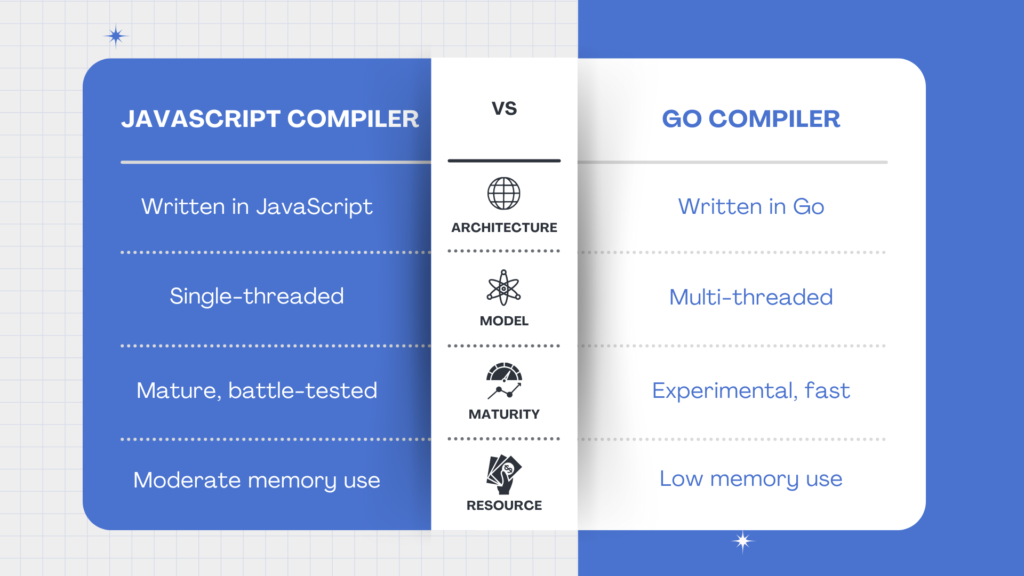
| Metric | JavaScript Compiler | Go Compiler |
|---|---|---|
| Full build time | 77.8 seconds | 7.5 seconds |
| Memory usage | ~4.1 GB | ~512 MB |
| Concurrency | Single-threaded | Multi-threaded |
| Error diagnostics | Real-time | Real-time |
Analysis
The Go compiler not only delivered faster builds but significantly reduced the memory footprint, making it ideal for resource-constrained environments and CI/CD pipelines.
Real-World Speed Gains Across Popular Codebases
Microsoft tested the new Go-based TypeScript compiler across a variety of well-known open-source projects—including Visual Studio Code, Playwright, and TypeORM. The results show consistent, dramatic speed improvements in both build time and memory efficiency.
Performance Comparison
| Codebase | Size (LOC) | JavaScript Compiler | Go Compiler | Speedup |
|---|---|---|---|---|
| VS Code | 1,505,000 | 77.8s | 7.5s | 10.4x |
| Playwright | 356,000 | 11.1s | 1.1s | 10.1x |
| TypeORM | 270,000 | 17.5s | 1.3s | 13.5x |
| date-fns | 104,000 | 6.5s | 0.7s | 9.5x |
| tRPC (server + client) | 18,000 | 5.5s | 0.6s | 9.1x |
| rxjs (observable) | 2,100 | 1.1s | 0.1s | 11.0x |
Architecture Overview: What Changed?
The Go compiler isn’t a full rewrite of TypeScript—it’s a native compiler implementation that reads .ts files, parses them, builds the type graph, and emits .js files just like the original.
Notable Architectural Differences
- Language: Written in Go instead of JavaScript
- Concurrency: Uses Go routines to handle parsing, type checking, and emitting in parallel
- Performance: Optimized memory allocation, faster AST handling
- Compatibility: Supports most TypeScript config options and APIs (like tsconfig.json)
- Build pipeline: Rewritten with focus on CPU efficiency and cache-aware compilation
Benefits for Developers
Faster Feedback Loops
Faster compiles lead to quicker turnaround during development, especially when using strict mode or complex generic types.
Lower CI/CD Costs
Faster builds = fewer compute hours. This directly benefits companies using cloud-based build agents (GitHub Actions, Azure DevOps, CircleCI).
Scalable for Monorepos
Monorepos are increasingly popular. The Go compiler handles many sub-projects better in parallel, thanks to its concurrency model.
Simple Migration Path
Drop-in compatibility allows teams to test and migrate without massive tooling changes.
TypeScript Compiler Evolution
Challenges and Limitations
Despite the optimism, the Go compiler is still experimental. Microsoft has been transparent about the hurdles.
Current Limitations
- No watch mode: Cannot yet recompile files on change
- Incomplete plugin support: Plugins relying on tsserver may not work
- Learning curve: Go devs may need to learn TypeScript internals, and vice versa
- Ecosystem maturity: Limited community tools and support compared to tsc
- Edge cases: May behave slightly differently with uncommon TS features
This is a high-risk, high-reward project. We’re learning as we go.
Community Reactions and Ecosystem Impact
Developers on platforms like Dev.to, Reddit, Hacker News, and GitHub have been quick to weigh in.
What Developers Are Saying
- “Game-changing for enterprise-scale apps.”
- “Go’s speed finally gets paired with TS safety.”
- “Still rough, but so promising.”
Open Source Momentum
The GitHub project already has over 3,000 stars and dozens of contributors. It’s an active, fast-moving project with monthly updates.
Key Features Comparison
| Feature | JavaScript Compiler | TypeScript-Go |
|---|---|---|
| Build Speed | Slower in large codebases | 10x faster |
| Memory Usage | High | Low |
| Plugin Support | Full | Partial (WIP) |
| Community | Mature ecosystem | Early adoption phase |
| Language | JavaScript | Go |
| Type Checking | Full | Full |
| Watch Mode | Yes | Coming soon |
Roadmap: What’s Coming Next?
According to the GitHub Roadmap, Microsoft plans to:
- Add watch mode support
- Improve incremental build performance
- Enhance editor services (for IDE integrations)
- Reach feature parity with tsc
- Expand community documentation and tooling
Microsoft also encourages developer feedback and contributions to prioritize improvements based on real-world use cases.
Use Cases: Where TypeScript-Go Shines
Enterprise Applications
Vast codebases like banking, logistics, and healthcare platforms can benefit from significantly faster build times and improved scalability.
Monorepos
Projects with shared libraries and multiple packages can take advantage of parallel processing and reduced compilation overhead.
CI/CD Pipelines
Faster builds translate directly into quicker deployments and reduced infrastructure costs.
Open Source Projects
Maintainers and contributors benefit from shorter feedback loops and a more responsive development experience.
A Promising Future for TypeScript
The move to Go marks a bold new chapter for TypeScript. While still in its early stages, the Go-based compiler delivers dramatic performance improvements, particularly for enterprise-scale projects. Microsoft’s commitment to maintaining backward compatibility means that most teams will be able to test and adopt this seamlessly.
If you’re managing a large codebase, it’s worth keeping a close eye on this project—or even contributing to it. As TypeScript evolves beyond performance limits, this initiative could redefine what’s possible in typed JavaScript development.
According to Microsoft.com
Conclusion
Microsoft’s Go-based TypeScript compiler represents one of the most significant advancements in the language’s history. By addressing long-standing performance and scalability challenges, it provides a path toward faster development workflows, reduced infrastructure costs, and a better experience for teams managing large-scale applications.
Although still experimental, the impressive benchmark results and strong community interest suggest a promising future. As development continues and feature parity improves, TypeScript-Go could become the next major milestone in the evolution of modern web development.